TERMS & CONDITIONS AT THE ANAHUACALLI
Audioreactive video mapping and lighting design · Anahuacalli Museum · Mexico City
Tom & Collins closed the year at the Anahuacalli Museum, the volcanic stone masterpiece built by Diego Rivera in Coyoacán.
Four sets throughout the night. A heritage site as a stage. Zero intervention on the building.
The building was not the backdrop of the show. It was part of it.

The Challenge
The concept for Tom & Collins' Terms & Conditions tour centers on actively integrating the architectural space into the stage experience. Its first milestone was established at the Alhóndiga de Granaditas, where a large-scale video mapping fused historical heritage with electronic music.
After that initial event, the mandate was clear: each stop on the tour had to surpass the last. The risk was preventing the video mapping from becoming merely decorative instead of driving the energy of the dance floor.
The ultimate test came at the Anahuacalli Museum. The imposing volcanic stone structure, designed by Diego Rivera and Juan O'Gorman, left no room for error on a night where three opening acts set the stage for the Mexican duo's headlining set.
Added to this was the nature of the venue: a heritage site with an irregular surface, where every setup and lighting decision had to be resolved without altering the structure and in perfect coordination with the rest of the concert production.
The Decisions That Sustained the Night
Three decisions defined the project.
The first was to build on a file already proven in that building. Tom & Collins did not arrive at voidXR from a cold search: during scouting, the museum itself showed them a video mapping that voidXR had previously created at the Anahuacalli for a wedding. They liked certain scenes so much that they asked to reuse them. The studio was already familiar with how the stone reacts under projection and the care the venue demands, arriving at the first meeting with content the client had already approved.
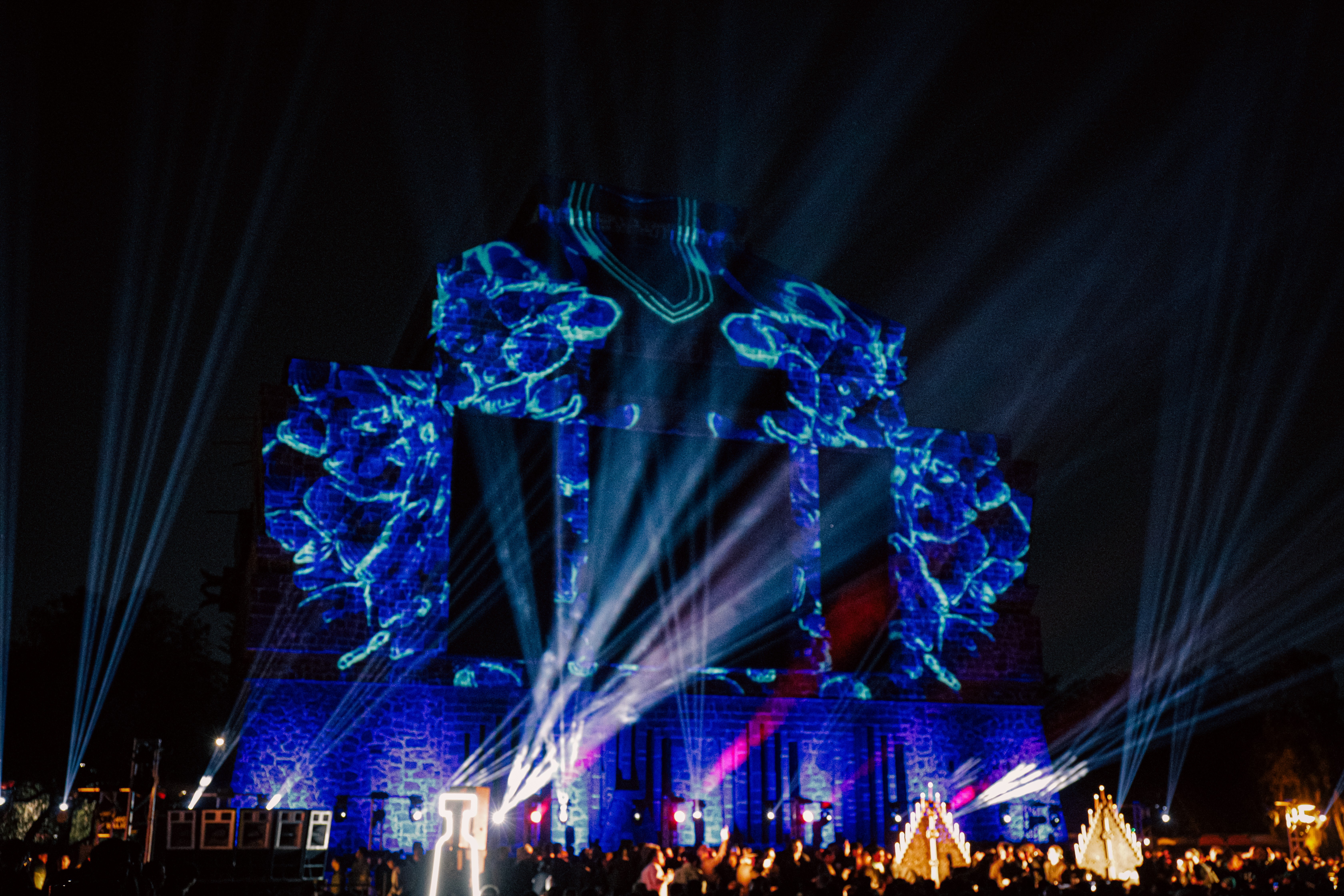
The second was to map the upper section and address the lower section with lighting. Instead of covering the entire facade with projection, the lower level was handled with an installation of moving heads synchronized with the video mapping above. The two systems operated as a single unit: each with its moments of prominence, and in certain passages acting in unison. The entire building is legible even though only a portion is projected, and neither the video mapping nor the lights detract from the other's presence.
The third was to make the content respond to live audio. The scenes do not run in a closed loop: they feed off the signal of each DJ, with lines and textures that pulse to the music. A sensor captures the silhouette of the artist in the booth and projects it back onto the stone, combined with color and texture according to the moment of the set. On top of the existing file, projection masks were built to restore volume to the building instead of flattening it—the resource most utilized throughout the night.


What the Audience Experiences
The opening sets warm up the stage. The building accompanies them with subtle movement and spaced transitions as the dance floor fills.
With Tom & Collins taking the stage, the building shifts gears. Animation speeds increase, textures gain volume, colors narrow to reds and ambers, and the light lines pulse with every track. The lower-level lighting follows the exact same beat, meaning the reaction comes not from a projected strip, but from the building's entire volume.
At the peak of the night, the silhouette of the Mexican duo appears on the stone, blending with those textures.
The audience is not looking at a screen installed in front of the museum. They are watching the Anahuacalli respond to the music, in real time.
The Process Behind What Matters
The content was reviewed scene by scene with the client. This review established the guiding criteria for the rest of the project: transitions align with the music and are never abrupt, and the event logo adopts the dominant color of the scene in which it appears.
The audio-reactive programming and silhouette sensor were integrated and tested in the lab before arriving on site. On installation day, December 19, the focus was on calibrating against the real-world conditions of the building and audio, not building the system under pressure.
voidXR did not operate in isolation. The design was coordinated with the rest of the concert production: the lighting engineer, the audio system team, the booth and stage setup, and the venue logistics. This coordination is the reason the video mapping and lighting functioned as a single, cohesive system.


The Result
The show ran in full, across all four sets, with zero interruptions in the projection or the audio-reactive response.
During the final review, the client requested that their favorite scenes from the archive be programmed to play during the peak moment of the evening.